A Survey With A Clear Business Purpose
A useful drain survey begins with the question you need answered. A facilities manager investigating repeat blockages needs a different scope from a contractor checking a proposed connection or a landlord reviewing a commercial lease. Tell us who will use the report and what decision depends on it.
A camera inspection can identify visible cracks, open joints, root ingress, deposits, displaced connections and standing water. It can also help trace the route between accessible chambers. It cannot certify the condition of every buried asset or reveal the outside of a pipe through its wall.
For acquisition or lease work, agree which buildings, external yards and drainage types are included. Foul and surface water systems should be identified separately where possible. Missing access, flooded sections and unknown connections should appear as limitations, rather than being treated as inspected drainage.
What The Camera Inspection Involves
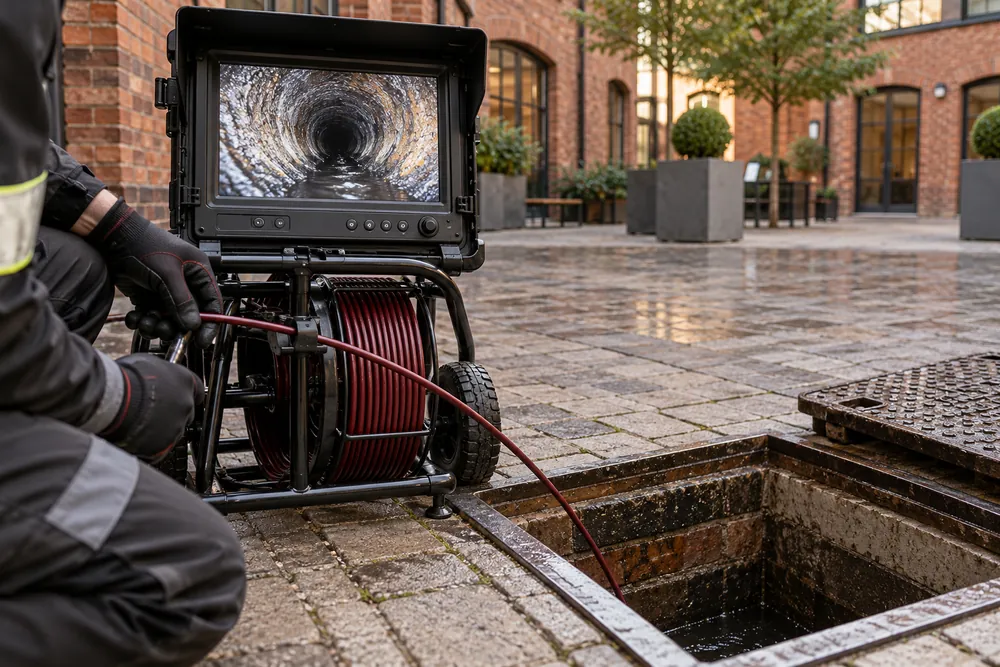
Push-rod cameras suit many smaller accessible runs, while crawler equipment may suit larger pipes. The choice depends on diameter, access and the distance to be surveyed. A locating sonde can help mark the position of a feature where the equipment and ground conditions allow it.
Heavy deposits can hide defects and prevent the camera from travelling. Cleaning may be needed first, but that should be agreed as part of the scope. If a blockage stops the survey, the report should identify the survey endpoint and explain what could not be assessed.
A camera image is useful only when it can be related to an asset. Ask for chamber references, direction of travel, pipe dimensions where measurable and distances along the run. These details help a repair contractor find the defect and reduce ambiguity when several lines serve one building.
Reports Your Facilities Team Can Use
Agree the deliverables before the visit. Depending on the brief, these can include recorded footage, still images, a defect schedule and a drainage sketch. An indicative route sketch is different from a measured topographical survey, so specify positional accuracy if it matters to your project.
BS EN 13508-2 is the visual inspection coding standard for drain and sewer systems outside buildings. Ask for the coding format required by your consultant or asset manager. A coded inspection describes observations and does not, by itself, design a repair or establish the legal ownership of a sewer.
Safe Access And Survey Limitations
Survey work should normally be planned from ground-level access. HSE guidance on the Confined Spaces Regulations 1997 makes avoiding entry the starting point. A camera inspection is not permission for staff to enter a chamber, and any specialist entry must be planned separately.
High water levels, bends, debris and inaccessible covers can limit the inspected length. A camera survey alone does not prove that a pipe is watertight. If leakage testing, connection tracing or a build-over assessment is needed, identify that requirement before the quotation is agreed.
What Affects A Survey Quotation
Cost depends on the number and length of runs, access, pipe sizes, cleaning requirements and reporting detail. Work in a busy loading area may require traffic controls or an agreed access window. An unknown network can need an initial investigation before a fixed survey extent is realistic.
Send previous reports, site drawings and the reason for commissioning the survey. Confirm whether the price includes footage, a written report and follow-up discussion of the findings. If a defect needs repair, request a separate proposal that refers to the observed location and explains the available options.
From Enquiry To Handover
- Share The Site Details. Include the postcode, the symptoms and any previous reports. Identify a person who can explain site access and authorise the agreed work.
- Agree The Method And Scope. Confirm the affected runs, equipment, safety arrangements and working window. Clarify what is included and how any change will be priced before it is carried out.
- Review The Outcome. Ask for the agreed completion record and discuss any limitations. Keep the findings with your maintenance records and approve any further investigation as a separate decision.
CCTV Drain Surveys FAQs
Will I Receive Drain Survey Footage?
Drain survey footage should be agreed as a named deliverable before attendance, alongside the report format and any drainage sketch. Ask how recordings will be supplied and how runs will be referenced. A useful handover links observations to identifiable chambers and distances, with clear notes on sections the camera could not reach.
Does A CCTV Survey Prove A Drain Is Watertight?
A CCTV drain survey records visible internal condition but does not by itself prove watertightness. Small leaks or defects hidden beneath water and deposits may not be visible. If your project needs a leakage test, structural assessment or approval for building work, specify that requirement so the correct additional investigation can be considered.
Should Drains Be Cleaned Before A Survey?
Drain cleaning before a CCTV survey may be needed when deposits obscure the pipe or prevent camera travel. Cleaning is not automatically necessary for every run. Agree whether the visit includes initial inspection, cleaning and a further camera pass, and ask for any remaining visibility limits to be recorded in the report.
Guidance Behind This Page
Read Approved Document H, HSE confined spaces guidance and GOV.UK business waste responsibilities. These references explain relevant duties and guidance, rather than a claim of accreditation.